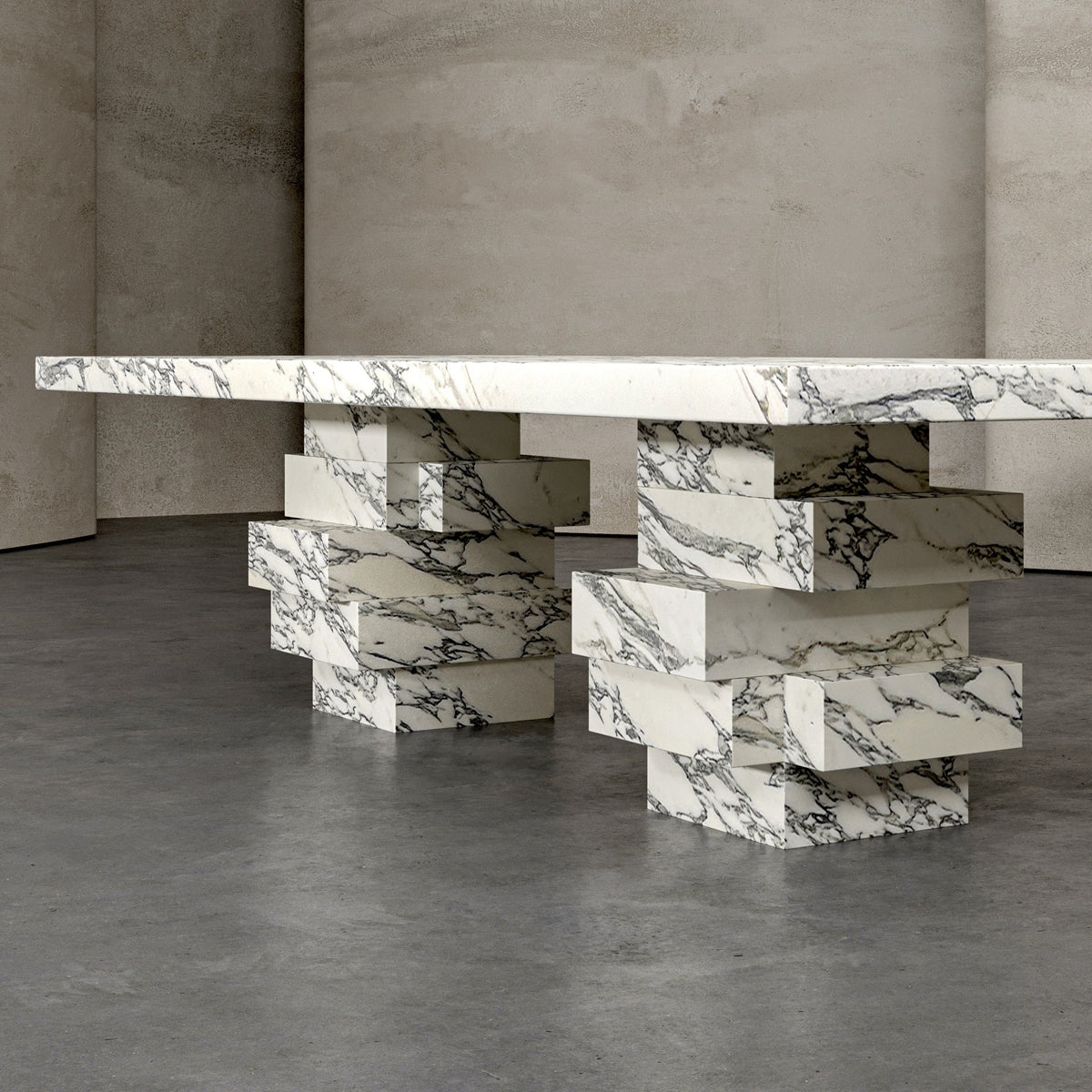

How to Care for a Marble Dining Table
Most of the damage we are asked to repair on marble dining tables was not caused by carelessness. It was caused by someone cleaning thoroughly with the wrong product, or by a bottle of olive oil left standing overnight. Marble is durable enough to have survived three thousand years of architecture, and fragile in two specific ways that no sealer will change.
This guide covers what actually marks a marble table, how to clean it day to day, when sealing helps and when it does not, and how to lift a mark that has already happened.
Etching and staining are different problems
They look similar and they are opposites, which is why so much advice online is useless.
Etching is a chemical burn. Marble is calcium carbonate, and acid dissolves it. Lemon juice, vinegar, wine, tomato sauce, cola, and many household cleaners will leave a dull patch where the polish has been eaten away. Nothing has soaked in; the surface itself has changed. Etching happens in seconds and no sealer prevents it, because a sealer sits in the pores rather than over the surface.
Staining is the opposite. Something has soaked into the stone and coloured it from within: oil, red wine left standing, coffee, ink. Stains are darker rather than duller, and they can usually be drawn back out.
The practical test: if the mark is lighter and duller than the stone around it, it is etching. If it is darker, it is a stain.
Finish changes how much you will see
A honed, matte surface is far more forgiving than a polished one. Etching shows as a change in gloss, so on a matte surface there is very little gloss to lose. The same acid spill that is invisible on honed Carrara will be obvious on polished Carrara under a pendant light.
This matters most on a dining table, which sees more acid in a week than a console sees in a year. If a table is going into a household that eats at it daily, we recommend honed nearly every time, and specify it as standard unless a client asks otherwise.
Everyday cleaning
The routine is short, and the list of things to avoid matters more than the list of things to use.
- Wipe with a soft cloth and warm water. For anything greasy, add a drop of pH-neutral washing-up liquid, then wipe the residue off with clean water.
- Blot spills rather than wiping them. Wiping spreads a spill across a wider area of stone.
- Dry the surface afterwards. Standing water leaves mineral marks, particularly with hard water.
Do not use vinegar, lemon, bleach, bathroom or kitchen sprays, descalers, cream cleaners, scouring pads or anything labelled antibacterial without checking it is safe for natural stone. Most supermarket cleaners are mildly acidic or abrasive, which is exactly what marble cannot take. A stone-specific pH-neutral cleaner costs little and removes the guesswork.
Sealing: what it does and does not do
An impregnating sealer soaks into the top few millimetres of stone and slows absorption. It buys you time to blot a spill before it becomes a stain. It does not make marble stainproof, and it does nothing at all against etching.
Test whether yours needs redoing with water. Leave a tablespoon of water on the surface for fifteen minutes, then wipe it off. If the stone underneath has darkened, absorption has begun and it is time to reseal. If it looks unchanged, leave it alone.
For a dining table in regular use, that test usually comes due once or twice a year. Polished surfaces absorb more slowly than honed ones. When you do reseal, work in a well-ventilated room, apply thinly with a cloth, let it sit the time the manufacturer states, and buff off every trace of excess before it dries, or you will be left with a hazy film that is harder to remove than the original problem.
Lifting a stain that has already gone in
Patience works better than chemistry. The method is a poultice: a paste that sits on the stain and draws it out as it dries.
- Mix baking soda with water to the consistency of thick yoghurt. For an oil stain, mix it with acetone instead of water.
- Spread it about half a centimetre thick over the mark, slightly wider than the stain itself.
- Cover with cling film, tape the edges, and pierce a few small holes so it dries slowly.
- Leave it for 24 to 48 hours, then scrape it off with a plastic edge and rinse with clean water.
Faint stains often lift in one application. Older or deeper ones can take three or four. It is slow, it is dull, and it works far more often than aggressive scrubbing, which only damages the surface further.
Etching is a different repair. Light etch marks on a honed surface can sometimes be blended back with a marble polishing powder. Anything deeper, or on a polished surface, needs a professional stone restorer with diamond pads, who will refinish the area and then the whole top so the sheen matches.
Heat, weight and the everyday hazards
Marble does not burn, but a hot pan straight from the oven can shock a polished surface and, on a cold day, thermal shock can crack a thin top. Use trivets. Put felt pads under anything ceramic or metal that gets dragged, since most scratches on dining tables come from crockery and vases, not knives.
Do not sit or stand on a stone top. It is heavy and strong in compression, and comparatively weak in bending. Overhangs are where cracks start.
What good habits actually look like
You do not need coasters for water glasses on a sealed, honed top. You do need them for wine, coffee and anything citrus, and you need to blot a spill rather than promise yourself you will deal with it after dinner. That is roughly the whole discipline.
Marble in daily use develops a patina, and this is worth deciding your attitude to early. A table that is used every day for twenty years will not look like the day it arrived. In most of Europe that is considered the point. If you want a surface that stays exactly as delivered, a quartzite such as Patagonia, or sintered stone for outdoor use, is the more honest choice than a marble you will spend twenty years protecting.
When to call someone
Call a stone restorer for deep etching, a chip on an edge, a crack, or a stain that has survived several poultices. Repairs are routine work for a specialist and usually cost far less than people expect.
If you bought the piece from us, ask us first. We can often tell you from a photograph whether it is etching or a stain, and what to try. Every piece in the catalogue is made to order, so we know exactly which stone, finish and sealer your table left with. If you are still choosing, the dining tables we build most often come in both honed and polished finishes, and we will tell you plainly which one suits how you live.