
Which Marble Is Best for a Dining Table?
Choosing stone for a dining table is usually presented as a question of taste. It is mostly a question of use. The same slab that is perfect in a formal dining room used twice a month is a poor choice for a kitchen table where children do homework, and the difference has nothing to do with quality.
This guide sorts the common stones by how they behave, not by how they photograph, so you can narrow the choice before you start looking at slabs.
Three questions that decide most of it
- How often will you eat at it? Daily use means acid on the surface most days: citrus, wine, tomato, vinegar. That points to travertine, a quartzite, or a honed rather than polished marble.
- Can you live with change? Natural stone in daily use develops a patina. If that idea bothers you, say so now, because it changes the recommendation entirely.
- How big is the room? Heavily veined stones read as busy at close range and calm from across a large room. A dramatic slab in a small dining room can overwhelm it.
The classic whites
Carrara is the soft grey-white with fine, feathery veining, and it is the most forgiving of the white marbles because its veining is quiet enough that marks disappear into it. It is also the most available, which keeps the price sensible.
Arabescato has bolder, more dramatic veining on a whiter ground. It suits large tops where the pattern has room to run.
Calacatta is the whitest ground with thick, decisive veins, often warm gold or grey. It is the most expensive of the three and the most likely to be the thing people notice first in the room.
Calacatta Viola, with its purple and burgundy veining, has become the signature stone of the last few years. It is spectacular, and it is a commitment. Specify it when you want the table to be the event.
All four etch. On a honed finish it barely shows. On a polished finish, in a household that eats at the table daily, it will show within the first year.
Travertine, the quiet one
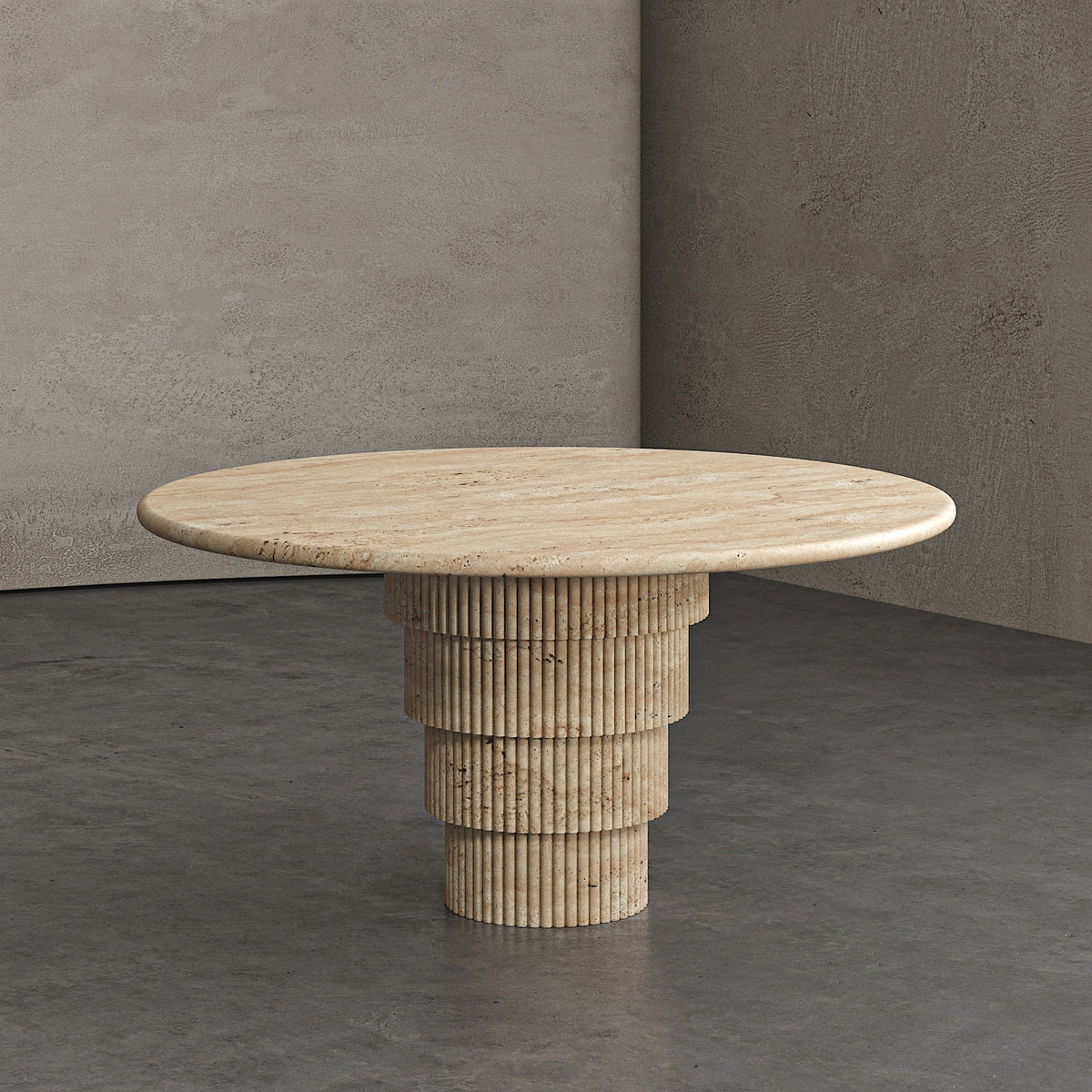
Travertine is the stone we specify most for tables that get used. It is warm, matte and forgiving, its tone reads as beige, cream, grey or red depending on the quarry, and marks blend into the natural texture instead of standing out against a polished field.
Filled travertine has its natural pores filled with a colour-matched resin, giving a smooth surface that wipes clean, which is what you want under plates. Unfilled travertine keeps the open pores, which looks wonderful and is a poor idea where food is served. For a dining table, specify filled.
The darks
Nero Marquina, black with sharp white veining, is the most graphic choice available and the strongest contrast with pale chairs and walls. Nero Antico and Nero Portoro run browner and gold-veined respectively.
Dark stone hides crumbs and rings, and shows dust, water spots and fingerprints. Etching is more visible on dark polished marble than on any other combination, because the dull patch reads as a pale ghost. Honed is the sensible specification.
Greens, reds and the statement stones
Verde Alpi and Indian Green are deep greens with white veining that look extraordinary with brass and warm timber. Rosso Levanto and Rosso Alicante bring oxblood reds. Breccia stones, with their fragmented, mosaic-like structure, sit between the two.
These carry a room on their own. Pair them with quiet chairs and keep the rest of the palette restrained, or the room starts to compete with itself.
When you want the look without the maintenance
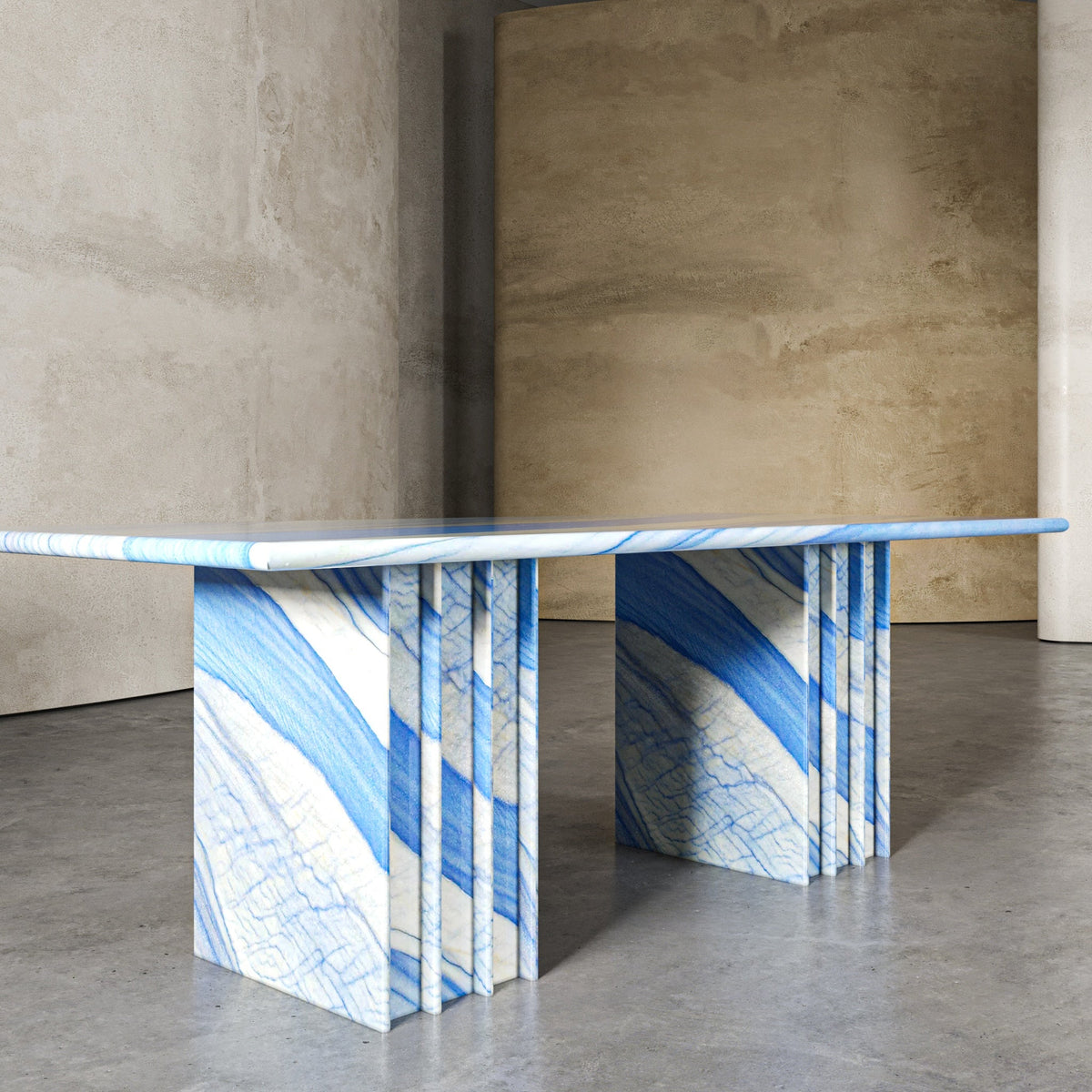
Quartzites such as Patagonia and Azul Macaubas are the answer for people who want drama and hate worry. They are considerably harder than marble and far more resistant to acid, so they etch very little. They cost more, and the most dramatic slabs are genuinely rare.
Sintered stone is manufactured rather than quarried, and it is effectively impervious: no etching, no staining, no sealing. It is the right answer for an outdoor table, and a reasonable one for a family kitchen where the goal is a surface that does not change. It will not have the depth of real stone when you look closely, and that trade is the whole decision.
Onyx is at the other end. Translucent, extraordinary when backlit, and too soft for a dining surface. Use it for a bar front or a console.
Finish, thickness and edge
Finish is the biggest practical lever after the stone itself. Honed for daily use, polished for formality and colour depth, brushed or leathered when you want texture that hides more than a polished surface will.
Thickness sets the character. A two inch top reads as refined, a four inch top as monumental, and the weight roughly doubles between them. The edge does the rest: straight for architectural, eased for a softened square, bullnose for something gentler, scalloped or wavy when the table is meant to be decorative. The edge profiles in the catalogue show each one drawn in section.
Match the slab, not the name
Stone names are not standardised. Two slabs sold as Calacatta Viola can differ enormously in ground colour and vein density, and there is no authority policing it. Never choose from a name or a swatch photograph alone.
Ask for photographs of the actual slab, with something for scale. For a large top, ask where the piece will be cut from the slab, since veining runs and its position across your table is a design decision. On a book-matched pair, ask to see the mirroring. Our samples exist for the same reason: screens flatten stone, and hand samples do not.
A shortlist by household
- Family kitchen, used daily: filled travertine, or a quartzite if the budget allows.
- Formal dining room, occasional use: Carrara, Arabescato or Calacatta, honed or polished.
- Small room, quiet scheme: Carrara or beige travertine, fine veining, two inch top.
- Large room, statement piece: Calacatta Viola, Verde Alpi, Rosso Levanto or Patagonia.
- Outdoors: sintered stone. Not marble, whatever anyone tells you.
Every table in the dining collection can be made in any stone in our library, at the length your room takes, so the design and the stone are separate decisions. Choose the shape you want to live with, then choose the stone for the life you actually lead.