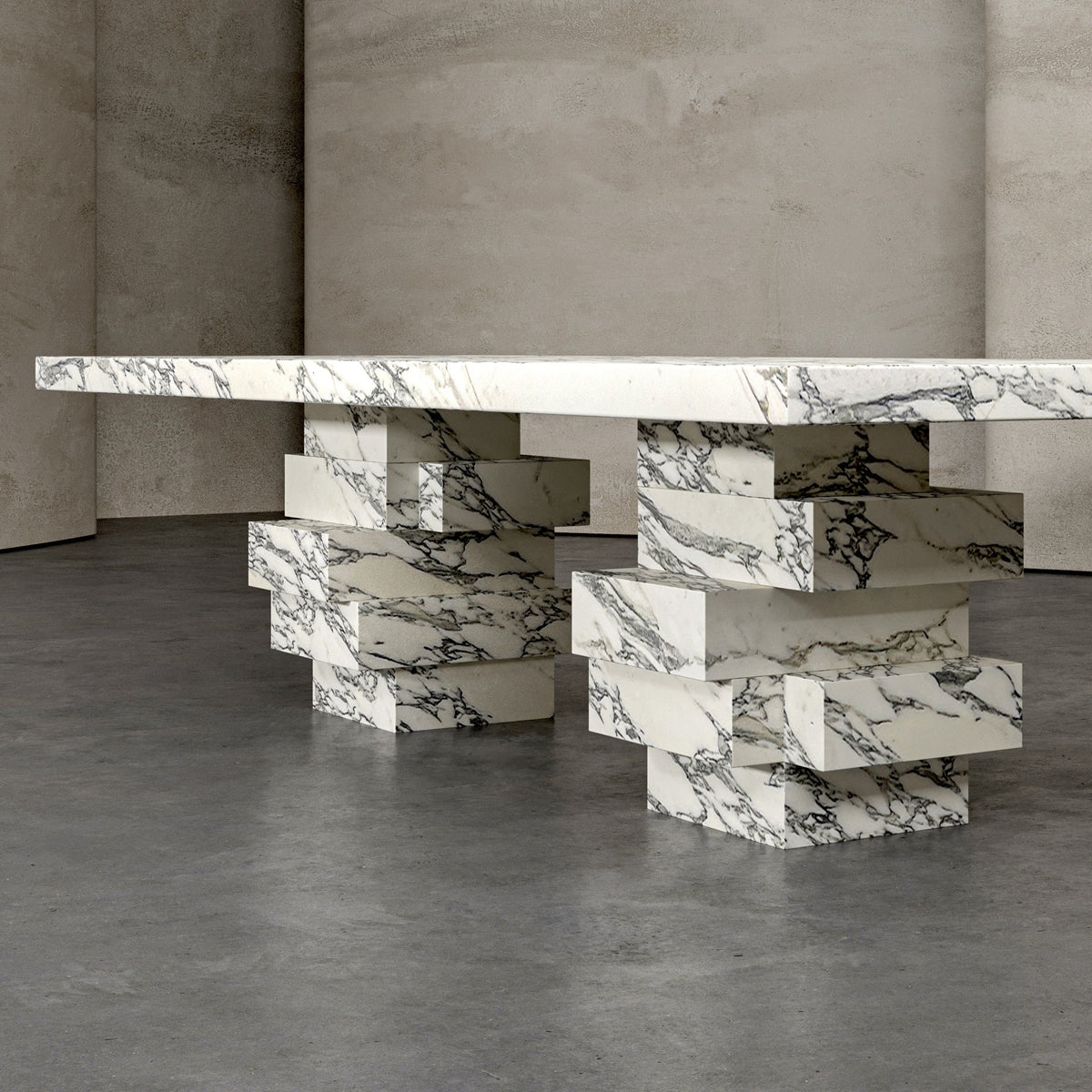

How to care for travertine furniture
Travertine asks very little of you, but the little it asks is specific. Most of the damage we are asked to repair was not caused by neglect. It was caused by someone cleaning carefully with the wrong product.
This covers what travertine is, what actually harms it, how to clean it day to day, when to seal it, and how to lift a stain that has already gone in.
What travertine is, and why it changes the rules
Travertine is a form of limestone, deposited by mineral springs, and it is made largely of calcium carbonate. Two consequences follow, and every care instruction below comes from one of them.
First, calcium carbonate reacts with acid. Anything acidic that touches the surface dissolves a microscopic layer of it. Second, travertine is porous. It formed around escaping gas, which left a network of voids running through the stone, and liquids will travel into them given time.
It is also a soft stone, sitting at roughly 3 to 4 on the Mohs hardness scale, where granite is 6 to 7. That softness is part of why it feels the way it does underhand. It is not a flaw to be corrected.
Filled or unfilled: know which you have
Travertine leaves the quarry full of natural holes. They can be left open, or filled with resin or cement before the surface is finished.
Filled travertine has a continuous surface. It is what most furniture uses, ours included, and it is considerably easier to live with: nothing collects in the holes and liquids have fewer routes in.
Unfilled travertine keeps its open texture. It is more dramatic and more characterful, and it demands more of you. Crumbs and dust settle into the voids, and a spill has somewhere to go.
If you are not sure which you have, run a fingertip across the surface. Filled travertine feels continuous. Unfilled catches slightly. The distinction matters for how often you will want to seal.
Everyday cleaning
Dust with a soft dry cloth. For anything more, warm water and a few drops of pH-neutral stone cleaner on a soft cloth, then wipe with clean water and dry the surface properly. Standing water is the most common cause of a dull ring on an otherwise perfect top.
Blot spills, do not wipe them. Wiping drags a spill across a wider area of porous stone and gives it more surface to soak into. Press a cloth down, lift, repeat with a clean part of the cloth.
What will damage travertine, in order of how often we see it:
- Vinegar and lemon. Both are frequently recommended online as natural stone cleaners. Both etch travertine on contact.
- Bathroom and kitchen sprays. Most descalers and limescale removers are acidic by design, because limescale is calcium carbonate. So is your table.
- Bleach and ammonia. Harsh on the sealer and on the stone.
- Abrasive pads and powders. A soft stone scratches, and the scratches will not polish out at home.
- Anything labelled simply "multi-surface". If the pH is not stated, assume it is not neutral.
Etching and staining are different problems
This distinction explains almost everything else, and it is the piece most guides leave out.
A stain is something that has soaked into the stone and sits inside it. Oil, wine, coffee. It is usually darker than the surrounding surface, and it can be drawn back out.
An etch is not a substance at all. It is a shallow patch where acid has dissolved the surface. It looks like a dull, slightly rough mark, often lighter than the stone around it, and it will not clean off, because there is nothing sitting there to remove.
The practical consequence is the one people find surprising: no sealer prevents etching. A sealer works below the surface, slowing liquids from entering. Acid acts at the surface, on the first crystals it touches, before the sealer becomes relevant at all. Sealing is genuinely worth doing, but it solves the staining problem, not the etching one.
Avoiding etching is a matter of habit rather than product: coasters under anything acidic, and a pH-neutral cleaner rather than whatever is under the sink. A honed finish, which is how most travertine furniture is supplied, hides the etching that does happen far better than a polished one would.
Sealing
Use a penetrating sealer, sometimes sold as an impregnating sealer or an impregnator. It soaks into the pore structure and cures below the surface, leaving no visible film. It does not change how the stone looks, and it lets the stone breathe. Avoid anything that forms a coating on top: coatings on travertine cloud, peel and trap moisture underneath.
How often depends on the piece and how hard it works. Interior surfaces generally want resealing every twelve to twenty-four months. A dining table in daily use, or anything unfilled, will be at the shorter end. A console table in a hallway can go considerably longer.
Rather than working to a calendar, use the water test. Put a few drops of water on the surface and leave them for five minutes, then wipe them away. If the stone has darkened where the water sat, it has absorbed it and the sealer has worn through. If the water beads and the stone underneath is unchanged, leave it alone.
Test any new sealer on an inconspicuous area first, and follow the manufacturer's instructions on dwell time. Wiping a sealer off too early is the usual reason one fails to work.
Lifting a stain that has already gone in
Once a stain is inside the stone, scrubbing the surface will not reach it. The method that works is a poultice: an absorbent paste spread over the mark, which draws the stain back out as it dries.
Mix a powdered poultice to the consistency of thick cream, spread it over the stain and slightly beyond it, cover with plastic film, and leave it to dry fully, which usually takes a day or two. As it dries it pulls the stain upward into the paste. Remove the dried paste, rinse, and repeat if the mark has faded but not gone. Two or three applications are normal for an old stain.
Match the liquid to the stain. Organic marks such as coffee, tea and wine respond to a poultice mixed with hydrogen peroxide. Oil and grease want a solvent-based mixture instead. Using the wrong one simply does nothing.
Heat, water and the everyday hazards
Travertine handles warmth better than it handles sudden change. A hot pan taken straight from an oven onto a cold stone top risks thermal shock, so use a trivet. Sustained warmth from a laptop or a lamp is not a problem.
Water rings are more common than heat damage and usually come from a glass left standing on an unsealed or tired surface. They are a mild form of staining and will normally lift with a poultice, or fade on their own as the stone dries over several days.
Travertine outdoors
Travertine performs well outside, which is why it appears around pools and on terraces. It stays cool underfoot and it is not slippery when wet. Two things change, though.
It wants sealing more often, roughly annually, because rain, sun and pool chemistry all work against the sealer. And in any climate that freezes, water held in the stone expands when it freezes and can break the surface. Sealing matters more in a cold climate than a warm one, not less.
Our guide to travertine tables outdoors covers siting and seasonal care in more detail.
When to stop and call someone
Deep scratches, chips, widespread etching and stains that have survived three poultices are all restoration work rather than cleaning. A stone restorer can hone a surface back, which removes etching properly by taking the surface down past it. It is not expensive relative to replacing a piece, and it is not something to attempt with a household abrasive.
If the piece came from us, tell us what happened and we will tell you honestly whether it needs a professional or a weekend.
If you are still choosing a stone, our guide to which marble is best for a dining table compares how each behaves in use, and stone samples let you judge the material in your own light before you commit.