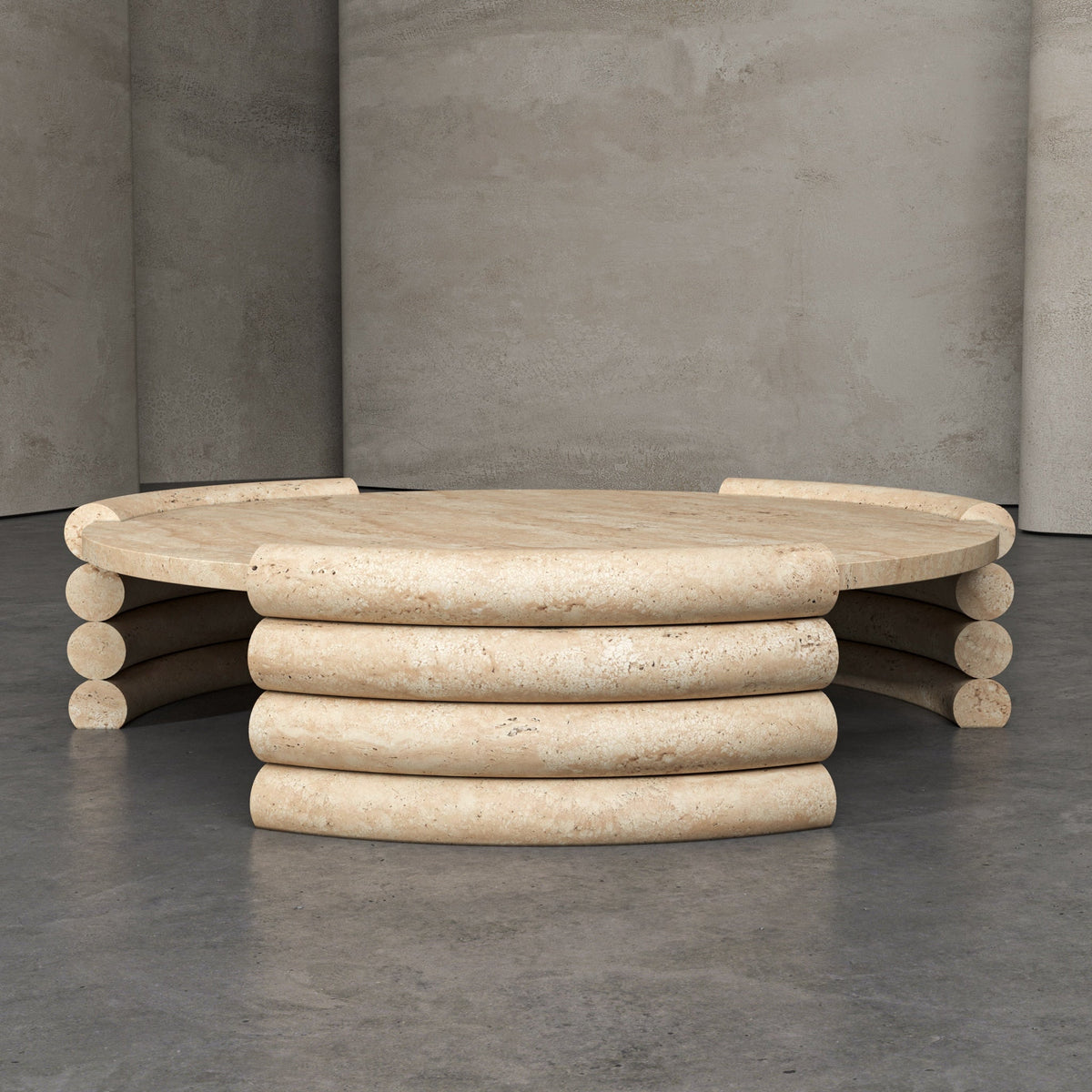

What Customizing Stone Furniture Really Means
"Custom" is the most overused word in furniture. It covers everything from choosing a colour on a catalogue item to commissioning a piece that has never existed. Both are legitimate. Knowing which one you are buying changes the price, the lead time and what can still be altered after you have paid.
This explains what is genuinely adjustable on a stone piece, what is fixed by the material, and where changes cost nothing versus where they cost a great deal.
The three levels of custom
Configured. An existing design, made in your choice of stone, size and finish. The proportions have been resolved before, the base is known to work, and the maker has built it. This is the least risky and usually the best value.
Modified. An existing design changed in a meaningful way: a different base under a known top, an unusual length, a shape altered to fit an awkward room. Some engineering is required, so there is a drawing stage and a price adjustment.
Bespoke. A new piece from a sketch, a photograph or an architect's drawing. Everything is decided from scratch, including whether it can be made at all in the stone you want at the size you want.
Most people asking for bespoke actually want configured, and are happier for it.
What changes freely
- Stone. Any design can be cut from any stone we can source. This is the single biggest change to how a piece looks and costs nothing extra beyond the material itself.
- Dimensions. Length, width, height and diameter are adjustable on nearly everything. Within a modest range this changes the material cost and nothing else.
- Finish. Honed, polished, brushed or leathered. Filled or unfilled on travertine. No structural consequence, a large visual one.
- Edge profile. Straight, eased, bevelled, bullnose, scalloped or wavy. Decorative edges take more hand work and are priced accordingly.
- Combining stones. A travertine base under a Calacatta Viola top, or the reverse. Two materials in one piece is one of the easiest ways to make something feel designed rather than bought.
What the material decides for you
Stone has rules that no amount of budget changes.
- Slab size. Blocks are finite. A single-piece top beyond roughly 120 by 60 inches becomes difficult and, in some stones, impossible. Beyond that you are looking at a seam, and where that seam falls is a design decision worth making deliberately.
- Thin sections. Stone is strong in compression and comparatively weak in bending. Slender legs, long unsupported overhangs and delicate cantilevers are where pieces crack in use, not in the workshop.
- Veining. You can choose which part of the slab your top comes from, but you cannot order veining to a drawing. Anyone promising otherwise is selling a printed surface.
- Weight. Scale is not free. A top that doubles in thickness doubles in weight, and at some point the floor, the lift or the staircase becomes the constraint rather than the design.
Where the cost actually sits
Four things move the price, in roughly this order.
- The stone. A rare quartzite can cost several times a common travertine for the same piece.
- Volume of material. Thickness and size, since you are buying cubic volume, not surface area.
- Hand work. Fluting, scalloping, carving and complex bases are hours, and hours are the cost.
- Engineering. Anything that has not been built before needs drawings, and sometimes a prototype.
The cheapest way to get something that looks entirely yours is to take a design that already works and specify it in an unexpected stone at the right size for your room. The most expensive is a new form in a rare stone at a size that pushes the slab.
How the process should run
Whatever the level of customisation, the sequence is the same, and each step ends in something you can approve or refuse.
- Room dimensions, use and access route.
- Design and stone shortlisted, with photographs of actual slabs.
- Dimensioned drawings showing top, base and how they meet.
- Written confirmation of stone, finish, edge, dimensions and lead time.
- Fabrication, with progress updates.
- Crating, freight and white-glove delivery into the room.
The drawing stage is where changes are free. After the stone is cut, they are not. Spend your attention there.
Questions worth asking your maker
- Can I see photographs of the actual slab before it is cut?
- Will you adjust the dimensions, and how does that change the price?
- Is the base a standard part or is it being made for this piece?
- Will this need a seam at the size I want, and where would it fall?
- What is the lead time, and what is it contingent on?
- What does delivery include, and what happens if it arrives damaged?
Every piece in the catalogue is made to order, so all of the above is on the table by default: any size, any stone in the library, any finish or edge. Start from a design you like in the collection, tell us the room, and we will tell you honestly which changes are free, which cost, and which the stone will not allow.