
Which Stone Lasts Longest Outdoors?
Any stone will survive outdoors for a season. The question is what it looks like after five years of sun, rain, frost and whatever gets spilled on it, and there the materials separate sharply.
This guide compares how each stone behaves outside, what actually destroys stone furniture in the open, and which material to specify for a terrace, a poolside or a restaurant courtyard.
What breaks stone outdoors
Four forces do nearly all the damage, and they are not equally present everywhere.
- Freeze and thaw. Water enters the pores, freezes, expands and breaks the stone from inside. This is the most destructive cycle in any climate with a real winter, and it is why porosity matters more outdoors than anywhere else.
- Ultraviolet light. Natural stone does not fade. The resins used to fill travertine and repair veins can, which is why a filled travertine top in full sun may lighten in patches over years.
- Rain and acid. Rainwater is mildly acidic, and in a city it is more so. On calcium-based stones such as marble and travertine it slowly etches the surface, which softens a polish into a matte finish over time.
- Salt. Near the coast, salt crystallises inside unsealed stone and works at it from within.
The materials, in order of how well they cope
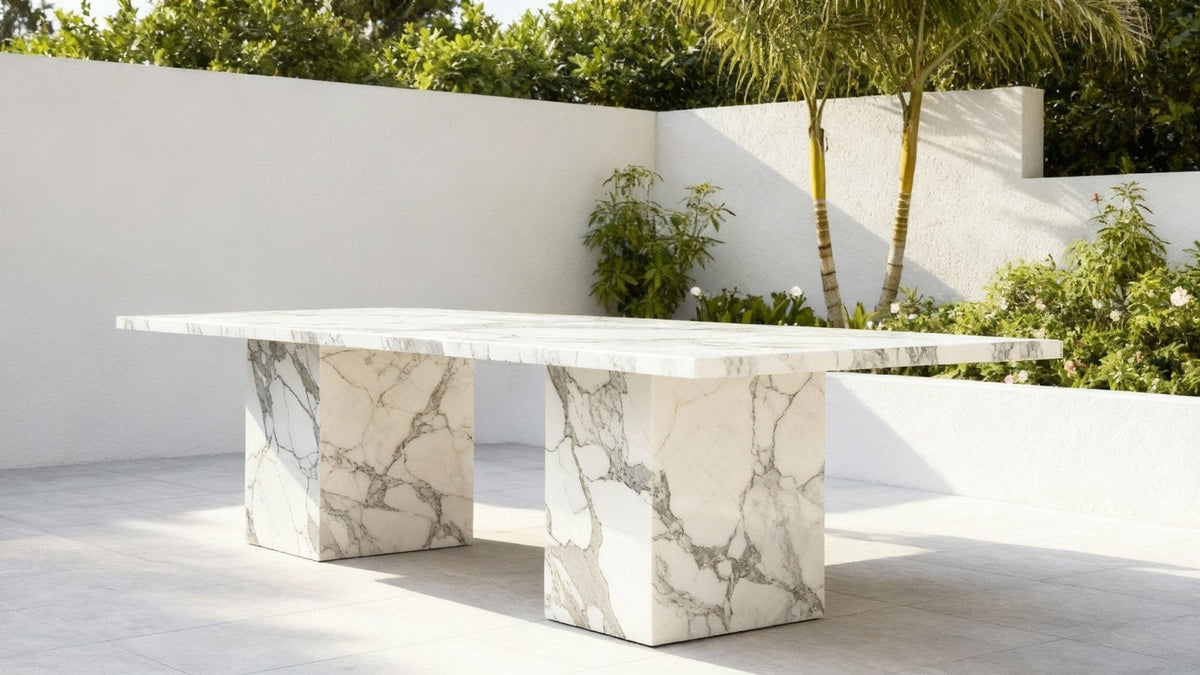
Sintered stone is the most durable answer available and the one we specify for outdoor tables. It is manufactured under heat and pressure, which makes it effectively non-porous: it cannot absorb water, so freeze-thaw is irrelevant, it does not etch, it does not stain, it is UV stable, and it never needs sealing. The trade is honesty of material. Close up it does not have the depth of quarried stone, and that is the whole decision.
Granite is the most durable natural stone outdoors. It is dense, hard, largely acid-resistant and handles frost well when sealed. It is also the least fashionable of the group, which is the only real reason it is not specified more.
Quartzite such as Patagonia or Azul Macaubas is hard, dense and far more acid-resistant than marble, and it performs well outdoors if sealed. It is expensive, and the most dramatic slabs are rare.
Travertine is the stone people most often ask about for terraces, because it is warm and matte and looks right in the sun. It is also porous. Outdoors it needs to be sealed and resealed, and in a climate with hard winters it will eventually spall. Unfilled travertine copes better outside than filled, because water passes through rather than lifting the resin. In a frost-free climate, in shade, sealed on a schedule, travertine outdoors is entirely reasonable. In Chicago or Toronto it is a slow-motion repair bill.
Marble is the weakest of the group outdoors. It is calcium carbonate, so acid rain dulls it, it is porous enough to suffer in frost, and a polished finish will not stay polished. Marble belongs indoors, or in a covered space in a warm climate where a weathered, matte patina is what you want.
Onyx should never go outside.
Can a travertine table be used outside?
Yes, with conditions, since this is the question we are asked most.
- Specify unfilled, or accept that filled resin may lighten in sun.
- Seal it with an impregnating sealer made for exterior stone, and redo it roughly annually, more often near salt water.
- Keep it out of standing water. Terraces that pond after rain are the problem, not the rain.
- In a freezing climate, bring it in for winter or cover it. Water in the pores is what cracks stone, not cold air.
- Blot spills. Outdoors, red wine and oil behave exactly as they do indoors.
If that list sounds like more attention than you want to give a garden table, specify sintered stone and stop thinking about it.
Bases, fixings and wind
Outdoor failures are as often structural as material. Stainless steel fixings should be A4 grade near the coast, since ordinary stainless will weep rust stains down a pale stone within a season. Feet need to sit level on a surface that moves with temperature, so pads that can be adjusted are worth having. And a large, light top on a slender base is a sail: in an exposed position, weight in the base is a safety feature, not just a look.
What to specify, by situation
- Poolside or coastal terrace: sintered stone. Salt and chlorinated splash rule out the porous options.
- Covered terrace, warm climate: travertine or quartzite, sealed, keeping dark stone out of direct afternoon sun.
- Restaurant or hotel courtyard: sintered stone for daily commercial use, where anything needing a maintenance routine will not get one.
- Cold climate, real winters: sintered stone or granite, or plan to bring the piece indoors.
- A sheltered spot you care about: whatever you love, sealed properly, accepting it will change.
Our outdoor tables are made in sintered stone in Calacatta white and travertine tones for this reason, and any design in the catalogue can be quoted in an outdoor-suitable material. Tell us where the piece will stand, including how much sun it gets and whether it freezes there, and we will tell you plainly what will still look good in ten years.