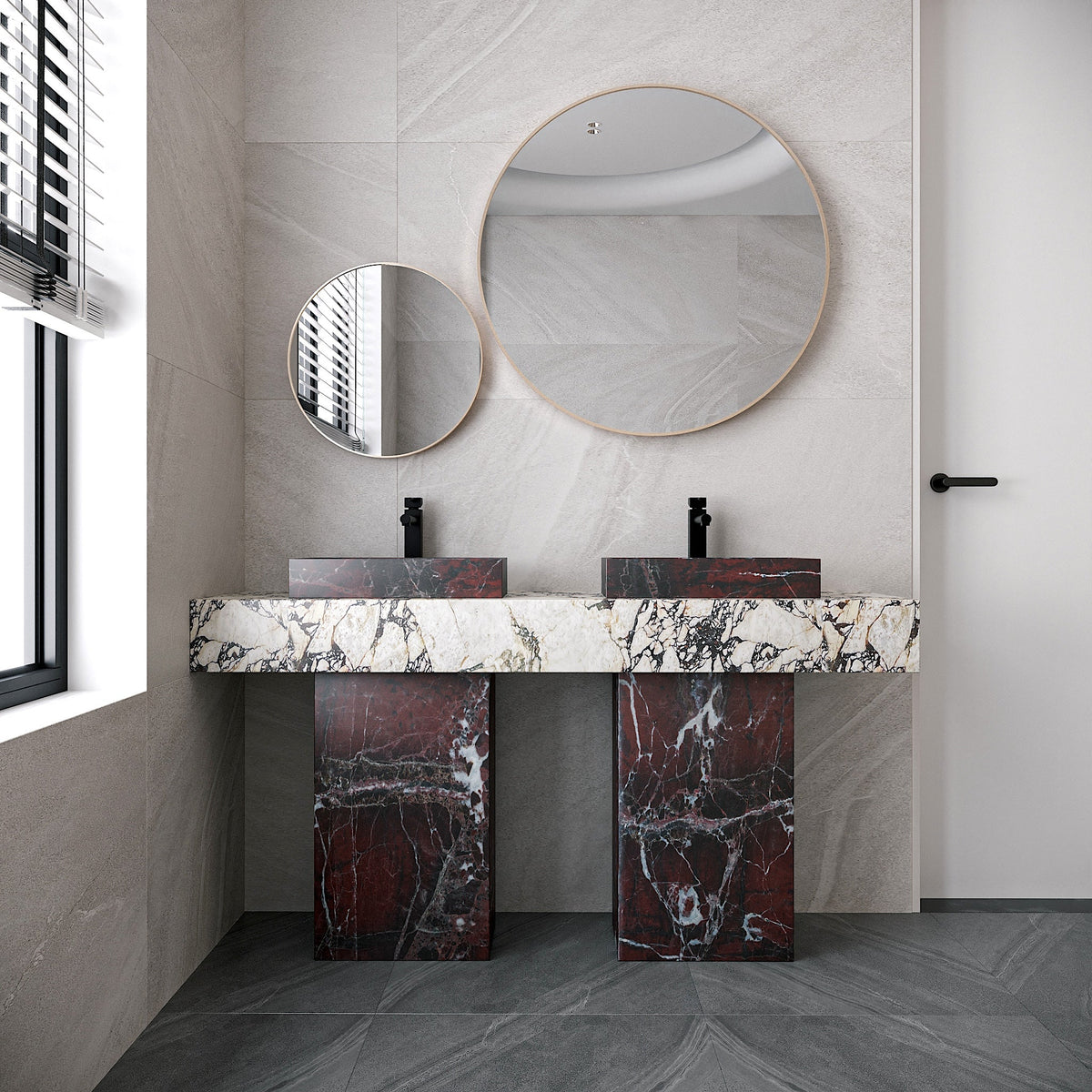

Marble and stone desks: the complete buying guide
A stone desk is one of the few pieces of furniture you touch for eight hours a day. That changes the questions worth asking about it. A stone dining table is used for an hour at a time and admired the rest of the day; a desk gets a laptop dragged across it, a coffee cup set down without a coaster, a pen pressed hard against a contract. It has to survive being worked at.
This guide covers what actually matters when you commission one: how a stone desk is built, which stones hold up to daily use, what one weighs, and what you will need to do to look after it. Some of it is less flattering than a showroom conversation. All of it is easier to hear before you order than after.
Solid stone, or a stone top on a base?
The first thing to establish about any stone desk is what it is underneath. Three constructions get sold under the same name.
A solid stone desk is cut from the same material throughout: top, legs, and any supporting structure. This is the heaviest and most expensive approach, and the only one where the edges of the desk show the stone's full depth. When you run your hand around the corner of a solid piece, the veining continues through it, because it is the same block.
A stone top on a different base pairs a slab with a frame in steel, brass, or wood. Lighter, often more affordable, and a legitimate choice. A slender metal base under a heavy top is a deliberate design decision, not a compromise. What matters is that the top is real stone of a specified thickness, and that the base is engineered for the load.
Stone-look surfaces are neither. Laminate, porcelain printed with a marble pattern, or a thin stone veneer bonded to a substrate. These have their place, but they are a different product answering a different budget, and you should know which one you are being shown.
If you already have a base you want to keep, or a joiner building one, a stone top can be supplied on its own and cut to your dimensions. It is a common request and a straightforward one.
Will a stone desk scratch?
Yes, and anyone who tells you otherwise is selling something.
Marble sits at roughly 3 to 4 on the Mohs hardness scale. Travertine is similar, sometimes a shade softer. For comparison, granite is 6 to 7 and quartzite 7 to 8. That gap is not academic: it means a steel object dragged across marble can mark it, where the same object across quartzite would not.
In practice, on a desk, this is less dramatic than it sounds. Laptops have rubber feet. Keyboards and mice do not scratch stone. The realistic culprits are a watch clasp, a set of keys tossed down, a metal ruler, or the base of a desk lamp being repositioned. None of these will ruin a desk; over years they accumulate as a faint patina.
The finish you choose matters more than the stone you choose. A honed surface hides scratches and wear far better than a polished one. Polished stone is a mirror, and every mark on a mirror announces itself. Honed stone is matte, scattering light instead of reflecting it, and small marks disappear into the surface. For a desk, which is a working surface rather than a display surface, honed is almost always the right answer.
Etching is not scratching, and no sealer prevents it
This is the single most useful thing to understand about natural stone, and the thing most often skipped.
Marble and travertine are calcareous: they are made largely of calcium carbonate. Calcium carbonate reacts with acid. When something acidic touches the surface, it dissolves a microscopic layer of the stone and leaves a dull mark. That mark is not a stain sitting on top of the stone; it is a change to the stone itself. It is called etching.
The acids that cause it are ordinary: lemon, wine, vinegar, fizzy drinks, and a surprising number of household cleaning sprays. On a desk, the usual offender is a citrus-scented surface wipe.
Here is the part that surprises people: no sealer on the market prevents etching. A sealer is an impregnating treatment that sits below the surface and slows liquids from soaking in; it is genuinely effective against staining. But acid acts at the surface, on the crystals it touches first, before any sealer becomes relevant. Sealing is worth doing. It simply solves a different problem.
What does help: a honed finish, where etching is far less visible; coasters for anything acidic; and pH-neutral cleaners rather than whatever is under the sink.
Which stone for a desk you will use every day
The honest answer depends less on the stone's name than on how you want it to age.
Travertine is the most forgiving surface for daily work, which is why it appears throughout our range. It is almost always honed, so it hides the small marks of use, and its natural texture gives the eye somewhere else to go. The trade-off is porosity: travertine is more absorbent than marble, so it wants resealing more often, roughly every six to twelve months against twelve to eighteen for marble.
Travertine also comes filled or unfilled. It leaves the quarry with a network of natural voids. Filled travertine has those voids closed with resin before finishing, giving a continuous surface that is much more practical under a keyboard. Unfilled leaves them open: more dramatic, more characterful, and considerably less suited to a desk where pens and crumbs will find every hole.
Dark marbles such as Nero Marquina hold their composure against fingerprints and dust, and read as serious in a way that suits a working room. They show pale dust more than they show marks.
White and pale marbles (Carrara, Arabescato, Calacatta Viola) are the ones people picture. They are also the least forgiving of a coffee ring, because the mark has nowhere to hide against a pale field. Beautiful, but choose them knowing that.
Green marbles such as Verde Alpi and Indian Green sit between the two: enough depth of colour to absorb everyday marks, enough character to be the reason you bought the desk.
What it weighs, and whether your floor should care
Stone is heavier than people expect, and desks are usually specified for upstairs rooms.
Marble weighs roughly 170 pounds per cubic foot. A slab at 3cm thickness, a normal specification for a desk top that needs to feel substantial, works out around 18 to 19 pounds per square foot. A 2cm slab is closer to 12 or 13.
Put numbers on a real desk. A top measuring roughly 160 × 70cm is about twelve square feet. At 3cm, that top alone is in the region of 220 pounds (around 100 kilograms) before you add a base. A solid stone base can easily double it.
Does that matter? Usually not. US residential floors are typically designed for a live load of 40 pounds per square foot in living areas and 30 in bedrooms, and a desk spreads its weight across a reasonable footprint. A ground floor or a concrete slab will not notice.
Where it is worth a conversation: an upper storey in an older building, a converted loft, or any room where the floor already feels lively underfoot. Concentrated loads sit outside what standard span tables cover, and a structural engineer will answer it in an afternoon. We would rather have that conversation before a piece is cut than after it is delivered.
Weight, in round numbers
- Marble density~170 lb / cubic foot
- Slab at 2cm12 to 13 lb / sq ft
- Slab at 3cm18 to 19 lb / sq ft
- A 160 x 70cm top at 3cm~220 lb / 100 kg
- US floor design load40 psf living, 30 psf bedroom
Drawers, cables, and the things a desk has to do
A desk is not a table. It has jobs a table does not.
Drawers in a stone desk are possible and more common than people assume; ours are built with them. The drawer box itself is not stone; it is a fitted unit integrated into the design, so it opens and closes like a drawer should while the visible surfaces stay stone. What matters is that it is designed in from the start rather than added underneath.
Cable management needs deciding early. A hole cut through stone is a one-time decision made in the workshop with the right tooling; it is not something to attempt afterwards. If you want power or data coming through the surface, say so when you specify dimensions.
Monitor arms are the most common late request and the hardest to accommodate. Most clamp to a desk edge and are designed for a 2 to 4cm panel with some give in it. Stone has no give, and clamping force in the wrong place is how edges chip. A freestanding monitor base, or a wall mount, avoids the problem entirely.
Looking after it
Day to day, a stone desk asks for very little: a soft cloth, warm water, and a pH-neutral stone cleaner when it needs more than water. What it asks you to avoid is the entire aisle of citrus and vinegar-based sprays.
Seal it on a schedule rather than when you remember: annually for marble, more often for travertine. The test is simple: put a few drops of water on the surface and leave them five minutes. If the stone darkens where the water sat, the sealer has worn through and it is time.
Spills want blotting, not wiping. Wiping spreads a stain across a wider area of a porous surface; blotting lifts it.
What drives the cost
Made-to-order stone is priced by the piece, and four things move the number more than anything else.
The stone itself. Rarity varies enormously between a widely quarried travertine and a book-matched slab of something scarce. This is usually the largest single variable.
Size, and more specifically yield. Stone is bought as a block or slab. A desk that fits efficiently within standard slab dimensions costs less than one that is fractionally too large and requires a second slab, most of which becomes offcut.
How much of it is carved. A rectangular top on a metal base is a different proposition from a solid piece with shaped edges, a curved profile, or an integrated drawer. Every one of those is workshop hours.
Getting it to you. Weight and fragility make freight a real line item, and white-glove delivery (getting a heavy, rigid object up a staircase and into a room without damaging either) is a specialist job.
Specifying one
If you are ready to have the conversation, four pieces of information move it fastest: the dimensions you have to work with, the room it is going in and on which floor, whether you need drawers or cable access, and any stone you already have in mind. From there we can tell you what is possible, what the lead time looks like, and where a different stone or a slightly adjusted dimension would serve you better.
If you would rather see the range first, our stone and marble desks are a reasonable place to begin, and if you already have a base you want to keep, a top on its own is entirely possible.
For more information contact us at hello@aprilsform.com